What is Databricks and Why Should You Care?
- Juan Diaz
- May 15, 2025
- 04 Mins read
- Databricks
In a world where data is the new oil, organizations are searching for tools that allow them to extract as much value as possible from this digital raw material. Databricks has emerged as an essential name in this landscape, valued at $62 billion and with more than 11,500 customers worldwide. But what makes this platform so special? Should you consider implementing it in your organization? Let’s unravel this technological phenomenon and discover if it’s the solution you’re looking for.
The Data Swamp: A Universal Problem
Before diving into Databricks, it’s crucial to understand the challenges it aims to solve. If these problems sound familiar, this blog is for you:
-
Tool fragmentation: Most companies use a patchwork of disconnected platforms: one for ETL and orchestration, another for machine learning, and various additional solutions for governance, dashboards, and business intelligence.
-
Information silos: Data gets trapped in compartments, making it impossible to get a unified view of the business.
-
Inconsistent governance: Security and access policies vary between systems, complicating regulatory compliance and the protection of sensitive data.
-
Difficulty scaling AI: Deploying machine learning models to production becomes a technical and operational odyssey.
Even with ambitious digital transformation projects and cloud migration, many organizations still struggle to implement a unified approach that works for all their teams. This is precisely the battleground where Databricks has planted its flag, with the all-in-one concept.
Databricks: The Unified Platform for Data and Artificial Intelligence
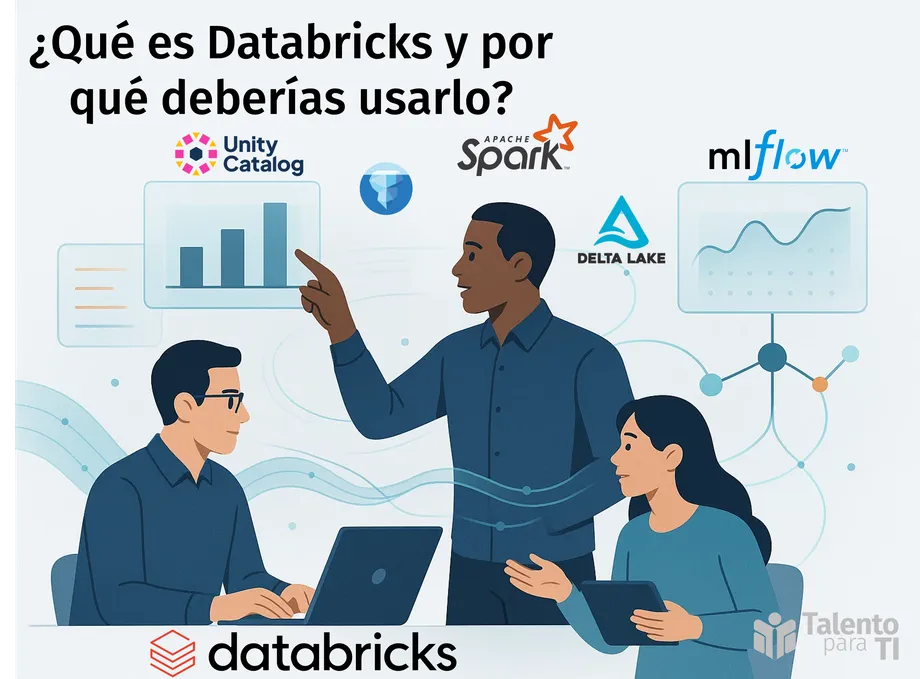
So, what exactly is Databricks? At its core, it is an “open” and unified platform for data and artificial intelligence founded by the creators of Apache Spark. This platform combines:
- Apache Spark: For scalable, distributed data processing
- Delta Lake: For reliable storage with ACID transaction support
- MLflow: For managing the entire machine learning lifecycle
- Unity Catalog: For governance, access control, and data lineage
These components form the foundation of what Databricks calls the “Lakehouse architecture” – an evolution that seeks to overcome the traditional limitations of data lakes and data warehouses.
The Lakehouse Architecture: The Best of Both Worlds
The Lakehouse concept, pioneered by Databricks, began to take shape in 2019 with the open-source release of Delta Lake. According to Forrester Wave 2024, 74% of global CIOs report having implemented a Lakehouse in their organizations, and nearly all the rest plan to adopt it within the next three years. But what truly sets this architecture apart?
Imagine an architecture that combines:
- The flexibility and cost-effectiveness of data lakes to store massive volumes of data in various formats
- The reliability, structure, and performance of traditional data warehouses
A Lakehouse allows you to:
- Ingest raw data from any source
- Store it in open formats like Delta or Iceberg
- Transform it at scale using Spark
- Run ETL processes in real time or in batches
- Implement complete machine learning pipelines
- Power everything from SQL dashboards to generative AI applications
All of this translates into a single platform where teams can collaborate seamlessly, eliminating the need for multiple tools and data silos. It’s multi-cloud, based on open-source technologies, and designed to provide an integrated experience.
Who is Databricks For? Roles and Benefits
Databricks is designed to serve multiple profiles within an organization:
Technical Roles
Data Engineers
- Build ETL pipelines using Apache Spark and Delta Lake, as Comcast does to process over 20 PB of data daily
- Develop real-time data integration processes, as implemented by Condé Nast to unify data from multiple digital platforms
- Leverage Databricks Workflows and Jobs API to orchestrate complex workflows, similar to how Shell optimized its seismic data processing
Data Scientists and ML Engineers
- Train predictive models as Starbucks did to optimize inventory and reduce waste in over 30,000 stores
- Use MLflow to manage the complete model lifecycle, as AstraZeneca does to accelerate drug discovery
- Implement Feature Store and Model Serving for real-time applications, similar to the recommendation system Adobe uses in its product suite
Data Analysts
- Run interactive SQL queries with Databricks SQL, as T-Mobile uses to analyze petabytes of customer data
- Explore data with collaborative notebooks, a practice adopted by Regeneron for genomic research
- Build operational dashboards or connect with BI tools like Power BI, Tableau, or Looker, as implemented by CVS Health for population health analysis
Business Roles
With Databricks Genie and the data intelligence platform, even non-technical users can:
- Ask questions using simple natural language (e.g., “Which products are underperforming this quarter?”)
- Get accurate answers immediately
- Access critical information without constantly relying on technical teams
The magic lies in the system’s true understanding of data relationships and specific business context, thanks to unified governance and integrated language models.
Security and Governance Teams
Unity Catalog allows you to:
- Manage data privacy, access, and lineage from a single point
- Maintain full control over data usage across teams and tools
- Implement consistent security policies throughout the organization
Highlighted Use Cases
Databricks is behind some of the most advanced AI and analytics use cases to date:
-
Customer Experience Personalization: Companies can analyze behaviors to develop retention strategies and personalized marketing campaigns that truly connect with their audience.
-
Fraud Detection and Prevention: Financial institutions implement real-time analytics to identify suspicious transaction patterns, protecting their customers and business.
-
Supply Chain Optimization: Organizations can predict demand, optimize logistics routes, and improve inventory management, minimizing disruptions and reducing operational costs.
Should You Adopt Databricks?
Databricks represents a significant investment, so it’s important to assess whether it’s right for your organization. Seriously consider adopting Databricks if:
- You handle large volumes of data that require scalable processing
- You have diverse teams (data engineering, data science, analytics) that need to collaborate efficiently
- You want to unify your data infrastructure and eliminate silos
- You want to accelerate your AI and machine learning initiatives
- You need better data governance across multiple systems
On the other hand, if your organization works with small datasets or has limited analytical needs, there may be simpler and more cost-effective solutions that better fit your case.
Conclusion
Databricks offers a unified vision that eliminates the fragmentation, complexity, and limitations inherent in traditional data ecosystems. Its collaborative approach enables different teams to work together efficiently.
With the continuous integration of AI capabilities and a solid foundation in open-source technologies, Databricks is not just a platform for managing data, but a strategic investment for the future of organizations.
The question is no longer whether your company needs a unified data strategy, but how to implement it most effectively. The benefits in terms of efficiency, collaboration, and speed of innovation can be transformative for your company.